
Why Most Curly Hair Extensions Go Straight (And What to Do Instead)
Why Most Curly Hair Extensions Go Straight (And What to Do Instead)
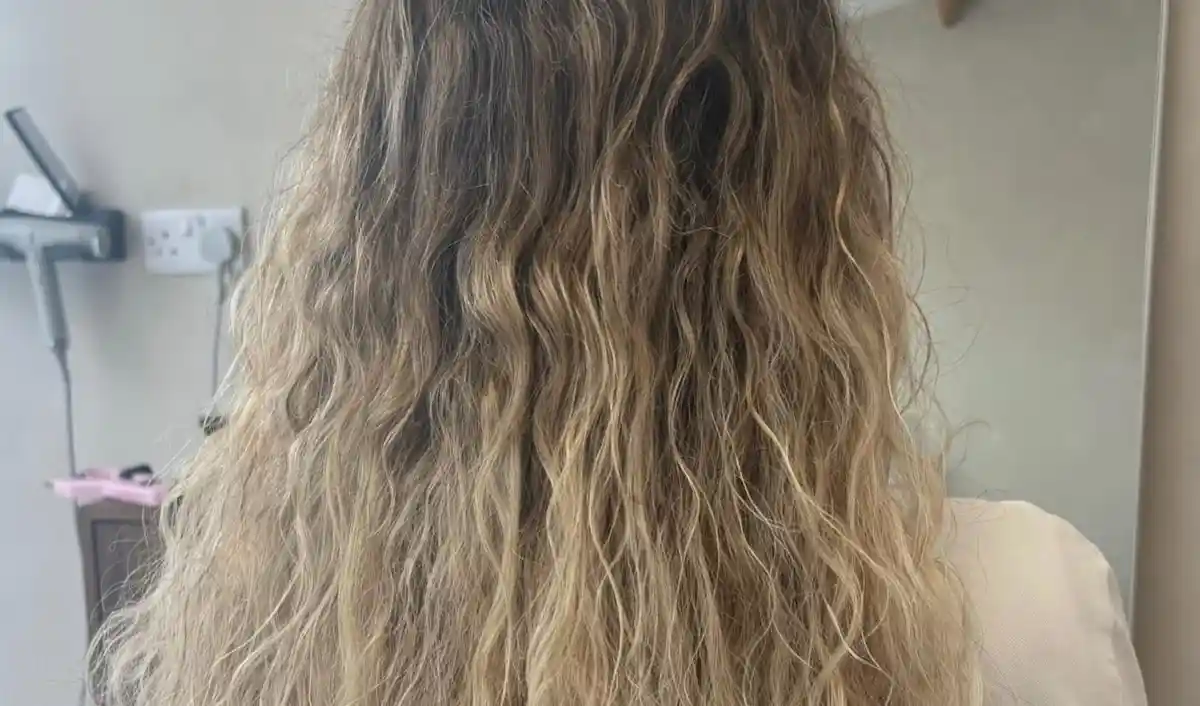
You booked the fitting. The before-and-afters were gorgeous. The stylist told you the curl would hold. And then, somewhere between wash three and wash six, the curl dropped. The shape is still there, vaguely, but it's loose and soft where it used to be defined. Nothing holds. And next to your own hair, the extensions feel like a slightly different material: glassier, coarser, reflective in a way your hair never was.
That isn't your stylist's fault, and it isn't your aftercare. It's the hair they had to work with.
This post is the honest structural explanation of why most curly hair extensions fail (including the ones sold as "premium"), and what genuinely different hair looks like when it's fitted properly.
Hair Extension Specialist & Founder of FAKE
With over 13 years of experience specialising in keratin bond and micro ring hair extensions, Kylie has completed over 5,000 individual fittings. She hand-blends and colour-matches naturally wavy and soft-curl Eastern European hair in-salon. FAKE serves North Yorkshire, County Durham and across the North of England.
The Short Version
A real curl is built into the hair before it leaves the scalp: in the shape of the follicle, the cross-section of the strand, and the way keratin cells are distributed inside it. You cannot install a curl from the outside. Every method that tries (perming, steam-processing, chemical waving) is fighting the strand's original geometry, and over weeks of washing and heat, the strand wins.
The extensions didn't drop the curl because they were badly made. They dropped it because structurally, they were always going to.
Where Extension Hair Actually Comes From
Walk into most high-street salons in the UK and ask where their extensions are sourced. If you hear "premium human hair" without a specific origin, it's almost certainly East or South Asian, typically Chinese or Indian in origin. That supply dominates the global market for a simple reason: it's abundant, long, strong, and commercially efficient to collect.[1]
The problem is that Asian hair is structurally different from European hair in ways that matter enormously if you're fitting it on curly-haired women.
The Cross-Section Problem (This Is the One Nobody Explains)
Hair fibres aren't perfectly round. Their cross-section, the shape you'd see if you sliced a strand, determines how the hair naturally sits.
Asian hair averages 80–100 micrometres in diameter with a rounder, more uniform cross-section and a thicker, more compact cuticle layer.[2] European hair averages 50–70 micrometres, with an oval or elliptical cross-section and a lighter cuticle.
Think of it this way: a round drinking straw stays straight. Flatten it slightly and it naturally wants to bend. The same principle applies to hair. The flatter the cross-section, the more the strand curves as it grows.[3]
Round-cross-section hair is the straightest hair on the planet, by design, before any styling is involved. It resists bending. No amount of heat, no amount of chemistry, changes that underlying geometry.
That's the first structural reason Asian-origin extensions don't match curly European hair: the fibre itself wants to be straight.
The Perm Problem: Why Chemically Curled Hair Always Drops
The industry's usual workaround is to take straight Asian hair and perm a wave or curl into it. It sounds sensible. It isn't.
What a perm actually does
A perm targets the disulfide bonds in keratin: the strong, covalent cross-links that hold the hair's internal protein structure in shape. A reducing agent (most commonly ammonium thioglycolate) breaks roughly 20–40% of those bonds.[4] The hair is wrapped around a rod, a neutraliser reforms the bonds in the new curved position, and the result looks like a curl.
Structurally, it's a curl in a different category entirely.
Why the curl fades
Research into perm-waved hair describes it as a thermorheologically complex shape-memory composite.[5] In plain English: the fibre remembers its original straight shape, and it quietly works its way back toward it. Every wash disrupts the hydrogen bonds supporting the new curl. The disulfide bonds reformed during perming are never as stable as the originals. Every hot shower, every round with the hairdryer, every humid day nudges the strand back toward straight.
A naturally curly strand, grown from a curved follicle with asymmetrical keratin distribution, has no "original straight shape" to return to. The curl is the shape. It comes back every time the hair is washed.
This is the fundamental difference: a permed curl is fighting its own structure. A natural curl is expressing it.
And the strand is weaker
Breaking 20–40% of a fibre's disulfide cross-links doesn't just change its shape. It weakens the hair.[6] The strand becomes more porous, more prone to tangling, and more fragile under tension. Extensions already have a finite lifespan. Starting that lifespan with compromised hair shortens it.
If the hair has also been bleached to achieve a lighter colour (which most Asian hair requires before it can be dyed to a European shade), you're stacking two forms of chemical damage. Bleaching breaks disulfide bonds too. A bleached-then-permed strand has lost a significant proportion of its structural integrity before it ever reaches your head.
And even when it holds, it still feels wrong
This is the part that catches most clients off guard. Even if a perm held the shape perfectly (which it doesn't), the strand's cross-section, cuticle weight and feel don't change. A permed Asian strand next to a naturally wavy European strand catches light differently, feels different between your fingers, and behaves differently when wet.
The shape might approximate your curl. The material never does. Your eye picks up the mismatch before your conscious brain can name what's off.
This is why we don't use chemically textured stock. Across 13 years of fitting extensions, Kylie has never worked with permed or steam-processed hair, and FAKE was built around that position from day one. You cannot fix a physics problem with chemistry.
So What Actually Works
The only hair that behaves like naturally curly hair is naturally curly hair, grown from a donor whose follicle shape, cross-section and keratin architecture produced the curl from the inside out. No perming, no steaming, no chemical shortcut.
That hair exists, but it's rare. Naturally wavy and curly European donors are a minority trait. The gene most strongly associated with straight hair in European populations sits at its highest frequency exactly where most donor hair is collected.[7] We hand-source and hand-blend every curly set we fit, toning where needed, because that's the only way to get stock that matches one specific head.
The full story of how we source it, why it has a lead time, why it costs more, and why we cut it dry, is in our sourcing guide.
And if you want the practical side of what a proper curly fitting looks like (what we match, which method suits your hair, and what to expect), the complete curly hair extensions guide covers all of it.
Had a Curly Set That Dropped? Let's Talk About What's Actually Possible.
Book a free consultation and we'll tell you honestly what your hair needs and whether we can match it.
Free consultation • No obligation • Expert guidance
FAQ
Can you perm hair extensions to make them curly?
Technically yes. It's done routinely. Structurally, it never holds. The curl relaxes progressively with every wash as the reformed disulfide bonds fail, and the strand is weaker to start with because bond-breaking is how perming works. We don't use chemically textured stock for this reason.
Why do my curly extensions go straight after a few washes?
Almost certainly because they were permed or steam-processed straight hair. The curl isn't built into the fibre. It's been held in place chemically, and the chemistry fails over time. Natural curl grown from the follicle doesn't behave this way.
Why do my extensions feel like a different material than my own hair?
Because they probably are. Most commercially available extensions are Asian-origin hair, which has a rounder cross-section and a thicker, more uniform cuticle than European hair. Even perfectly colour-matched, the fibre reflects light and feels distinct to the touch. The mismatch is structural, not cosmetic.
Is there such a thing as extensions that won't drop the curl?
Yes, if the curl is grown into the hair rather than added to it. Naturally curly European donor hair keeps its curl for the lifespan of the extension, because there's no original straight shape for it to return to. The match is built at the fibre level, not imposed after the fact.
References
- [1]Loussouarn, G. et al. International Journal of Dermatology "Worldwide diversity of hair curliness: a new method of assessment" (2007) Available at: https://pubmed.ncbi.nlm.nih.gov/17214714/ DOI: 10.1111/j.1365-4632.2007.03453.x
- [2]Loussouarn, G. et al. International Journal of Trichology "Asian Hair: A Review of Structures, Properties, and Distinctive Disorders" (2020) Available at: https://pmc.ncbi.nlm.nih.gov/articles/PMC7187942/ DOI: 10.4103/ijt.ijt_87_19
- [3]Thibaut, S. et al. Experimental Dermatology "The what, why and how of curly hair: a review" (2019) Available at: https://pmc.ncbi.nlm.nih.gov/articles/PMC6894537/ DOI: 10.1111/exd.14011
- [4]Wortmann, F.-J., Wortmann, G. Journal of Cosmetic Science "Action of Thioglycolic Acid and L-Cysteine to Disulfide Cross-Links in Hair Fibers during Permanent Waving Treatment" (2003) Available at: https://www.researchgate.net/publication/244751910
- [5]Popescu, C., Wortmann, F.-J. Scientific Reports "Perm-waved human hair: a thermorheologically complex shape memory composite" (2021) Available at: https://pmc.ncbi.nlm.nih.gov/articles/PMC8456181/ DOI: 10.1038/s41598-021-98354-3
- [6]Morel, O.J.X., Christie, R.M. Journal of Applied Polymer Science "The susceptibility of disulfide bonds to modification in keratin fibers undergoing tensile stress" (2022) Available at: https://pmc.ncbi.nlm.nih.gov/articles/PMC9247342/ DOI: 10.1002/app.52491
- [7]Medland, S.E. et al. The American Journal of Human Genetics "Common Variants in the Trichohyalin Gene Are Associated with Straight Hair in Europeans" (2009) Available at: https://pmc.ncbi.nlm.nih.gov/articles/PMC2775823/ DOI: 10.1016/j.ajhg.2009.10.003