Curly Hair Extensions UK: The Complete Guide (2A–3C)
The Definitive UK Guide to Curly Hair Extensions — From Loose Waves to Tight Ringlets
You've seen the transformations on Instagram. The volume. The bounce. The curls that look like they grew there. Then you've Googled "curly hair extensions" and landed in a world of bone-straight bundles being marketed as "body wave," or — worse — someone promising they'll just perm straight extensions to match your natural texture.
You've been let down before. Maybe the curl dropped after two washes. Maybe the extensions felt like a completely different material sitting next to your own hair. Maybe someone told you curly-haired women are "difficult to fit."
None of that is your fault. It's a supply-chain problem dressed up as a styling issue — and once you understand what's actually going on, the solution becomes obvious.
This is the complete guide to curly hair extensions in the UK. Every curl type from 2A through 3C. The real science behind why most extensions fail on wavy and curly hair. And what a proper, curl-matched fitting actually looks like when someone does it right.

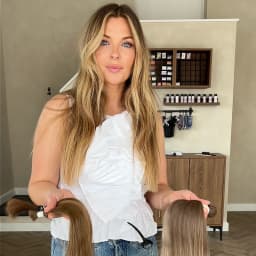
Hair Extension Specialist & Founder of FAKE
With over 13 years of experience specialising in keratin bond and micro ring hair extensions, Kylie has completed over 5,000 individual fittings. She hand-blends and colour-matches naturally wavy and curly Eastern European hair in-salon — one of the few specialists in the UK working with unprocessed curly stock. She brings specialist-level care to North Yorkshire, County Durham, and across the North of England.
Understanding Your Curl Type: 2A Through 3C
Before you look at a single extension, you need to know exactly what you're working with. The curl classification system uses numbers for shape and letters for diameter — and the distinction matters, because what reads as "curly" on a website covers an enormous range of hair that behaves in completely different ways.
Type 2: Wavy hair
2A — The barely-there wave. Your hair looks almost straight when wet but dries with a gentle S-bend, mostly from the mid-lengths down. It's fine, often flat at the crown, and loses its wave quickly under weight. This is the curl type most commonly dismissed as "not really curly" — which is precisely why most salons hand you straight extensions and tell you they'll blend.
2B — The definite wave. Stronger S-shaped waves that start closer to the root. You can see the pattern clearly when your hair is dry and product-free. It holds texture better than 2A, but it's prone to frizz in humidity. 2B is the single most common curl type we fit at FAKE — and the one the industry gets wrong most often, because it sits in a no-man's-land between straight and curly.
2C — The wave that's nearly a curl. Deep, defined waves with some actual ringlets mixed in. Your hair has real body, often a mind of its own, and frizz is a constant conversation. 2C hair has enough curl to look obviously wrong next to straight extensions, but not enough curl for many "curly" extension ranges, which tend to start at 3A.
Type 3: Curly hair
3A — Loose spirals. Well-defined curls roughly the diameter of a thick candle. Springy, with visible ringlets that form reliably after washing. 3A curls shrink noticeably from wet to dry — typically 20–30% shorter than they appear when soaking — which means length perception is something you have to factor in at the fitting stage.
3B — Medium spirals. Tighter, springier ringlets about the diameter of a marker pen. More volume, more shrinkage (sometimes 40–50%), and more variation across the head. It's common for 3B hair to have patches of 3A and 3C mixed in — the back of the head often curls tighter than the sides.
3C — Tight corkscrews. Densely packed spirals with significant shrinkage. Your hair might look chin-length when dry but reach your shoulders when stretched. 3C curls are among the most beautiful — and among the hardest to extend well, because any mismatch in diameter or spring tension shows immediately.
Why curl type alone isn't enough
Here's the thing most guides skip: two women can both have 3A curls and need completely different extensions. Curl type describes the shape. It doesn't tell you how thick each strand is, how many strands there are per square centimetre, how porous the hair is, or how light catches it. All of those variables change the way an extension blends — or doesn't. We'll come back to that.
If you want the full genetics deep-dive — how follicle shape, keratin distribution and specific genes like TCHH actually programme your curl before it leaves the scalp — we've written a separate piece on the science of curly hair extensions that goes into the biology in detail.
Why Most Curly Hair Extensions Are Straight Hair in Disguise
This is the part the industry doesn't like talking about.
The vast majority of hair extensions sold globally — including in the UK — originate from East and South Asia. Chinese and Indian hair dominates the supply chain for a simple reason: it's abundant, long, strong and commercially efficient to collect.[1]
The problem is that Asian hair is structurally different from European hair in ways that matter enormously for curly-haired women.
The cross-section problem
Asian hair has a rounder cross-section than European hair. Studies have shown it averages around 80–100 micrometres in diameter, compared to 50–70 micrometres for European hair, with a thicker, more compact cuticle layer.[2] European hair, by contrast, tends toward an oval or elliptical cross-section — and it's that asymmetry that allows it to bend and form natural waves and curls.
Think of it this way: a round drinking straw stays straight. Flatten it slightly and it naturally wants to curve. The same principle applies to hair fibres. The flatter the cross-section, the more the strand curves as it grows.[3]
Round-cross-section hair is straight by design. It's the straightest hair on the planet — and no amount of heat styling or chemical processing changes that fundamental geometry.
The light and feel problem
Even if you could somehow match the curl pattern (you can't, permanently — but we'll get to that), the hair itself would still feel wrong. A thicker, rounder cuticle reflects light in a glassier, harder way. Held against fine, soft, wavy European hair, it reads as a different material entirely. Your eye picks up the mismatch before your conscious brain even identifies what's off.
This is why so many women walk out of a salon thinking their new extensions look "fine" under the salon lights, only to feel increasingly wrong about them over the following week. It isn't the colour. It isn't the length. It's the fibre.
The scale of the issue
Walk into most high-street extension salons in the UK and ask what hair they use. If you hear "premium human hair" without a specific origin, it's almost certainly Asian-sourced. If you hear "body wave" or "natural wave," it's almost certainly straight hair that's been steam-processed or chemically permed into a wave pattern. And that brings us to the central problem.
The Perm Problem: Why Chemically Curled Extensions Always Fail
You'd think the solution would be obvious: take straight hair, perm it to match your curls, fit it. Job done. Except it doesn't work — and the reason it doesn't work is written into the molecular structure of the hair itself.
How a perm actually works
A perm is a two-step chemical process that targets the disulfide bonds in keratin — the strong, covalent cross-links that hold the hair's internal structure in shape. First, a reducing agent (usually ammonium thioglycolate) breaks roughly 20–40% of these bonds.[4] The hair is then wrapped around a rod to hold the desired shape while a neutralising agent reforms the bonds in the new position.
The result looks like a curl. But structurally, it's a compromised version of one.
Why the curl drops
Research into perm-waved hair describes it as a thermorheologically complex shape-memory composite — which, in plain English, means the hair "remembers" its original straight shape and quietly works its way back toward it.[5]
Every time you wash permed hair, the hydrogen bonds that support the new shape get disrupted and partially reset. The disulfide bonds reformed during perming are never quite as stable as the originals. With each wash cycle, each exposure to heat, each humid day, the curl relaxes a fraction more.
A natural curl — grown from a curved follicle with asymmetrical keratin distribution — doesn't do this. It's built in at every level of the fibre's structure, from the elliptical cross-section to the bilateral arrangement of cortical cells inside the strand.[3] There is no "original straight shape" for it to return to.
This is the fundamental difference: a permed curl is fighting its own structure. A natural curl is expressing it.
The damage problem
Breaking 20–40% of a fibre's disulfide cross-links doesn't just change its shape — it weakens it. The hair becomes more porous, more prone to tangling, and more fragile under tension.[6] Extensions already have a finite lifespan. Starting that lifespan with hair that's been structurally compromised shortens it considerably.
And if the hair has also been bleached to achieve a lighter colour (which most Asian hair requires before it can be dyed to match a European shade), you're stacking two forms of chemical damage. Bleaching breaks disulfide bonds too. A bleached-then-permed extension strand has lost a significant proportion of its structural integrity before it even reaches your head.
Why it still doesn't look right
Even if the perm holds (it won't, long-term), you're still left with the original cross-section problem. A permed Asian strand next to a naturally wavy European strand catches light differently, feels different between your fingers, and behaves differently when wet. The shape might approximate your curl. The material never does.
This is why, in 13 years and over 5,000 fittings, we've never used chemically textured stock. You cannot fix a physics problem with chemistry.

Natural curl has a movement and dimension that permed extensions can never replicate.
The Four-Variable Match: Curl, Density, Porosity and Colour
Here's something we tell every client at consultation: matching curly hair extensions isn't a one-variable job. It's a four-variable job. All four have to line up simultaneously, or the set won't read as yours. Get three right and miss one, and your eye — or anyone else's — will pick it up.
Variable 1: Curl pattern
This is the one everyone thinks about first, and it's important — but it's not as simple as "match the number."
A 2C wave and a 3A curl can look almost identical in a photo. In person, they behave differently. The 2C bends; the 3A springs. Put them side by side and they separate rather than blending — and your eye reads that separation as frizz.
We pattern-match to within one step of your own curl, then cut dry, with the curl in its natural resting shape, so the extension and your hair bed into each other rather than sitting as two distinct textures. This is something most salons skip — cutting curly extensions wet or straight, then expecting them to match once they dry. They won't.
Variable 2: Density
Curly hair looks voluminous long before the strand count is actually high. A head of loose 3A ringlets might look thick and full but actually have relatively low density — fewer hairs per square centimetre than you'd guess.
Over-fitting a curly head creates two problems. First, the weight pulls on follicles that aren't built for it — the same tension pathway we're so careful about in fine-hair fittings. Second, too many curls packed into too small a space crush each other's spring pattern, turning definition into bulk and making the whole set look like a wig.
We fit to real density, not apparent volume. That often means fewer strands than a client expects — and a result that moves and bounces far more naturally than a heavier set would.
Variable 3: Porosity
This is the variable most extension suppliers don't even acknowledge, and it's the one that causes the most aftercare frustration.
Porosity describes how easily your hair absorbs and loses moisture — and it's determined by the state of your cuticle layer. Curly hair is inherently more porous than straight hair, because the cuticle scales lift slightly around every bend in the curl.[7] That's why curly hair tends to be drier: moisture gets in fast and escapes fast.
If your natural hair is medium-to-high porosity (as most curly hair is) and your extensions are low porosity (as most heavily processed extensions are), the two will:
- Dry at different speeds. Your hair dries matte and fast; the extensions stay slick and wet for longer.
- Absorb colour differently. Touch-ups and toning treatments take unevenly across the set.
- Respond to products differently. Your hair soaks up a leave-in conditioner; the extensions sit under a film of product that weighs down the curl.
Over weeks, this porosity mismatch becomes more and more visible. It's one of the biggest reasons women say their curly extensions "looked great on day one and then went downhill." The extensions didn't change. The mismatch was always there — it just took time for day-to-day care to expose it.
We match to stock that behaves like your own hair — absorbs at the same rate, dries at the same speed, and takes products in the same way. It's one of the reasons we work with unprocessed European hair: its cuticle hasn't been stripped and re-coated, so it has real, readable porosity that we can match to yours.
Variable 4: Colour (and root dimension)
On straight hair, a single-process colour match is often enough. On curly hair, it's never enough.
Here's why: every curl creates depth. The inside of a bend catches less light than the outside. The roots sit in shadow where the curl springs away from the scalp. The mid-lengths reflect more. The result is that your natural colour has a three-dimensional quality — highlights and lowlights that exist without any deliberate colouring, just because of how your curl interacts with light.
A flat, single-block extension colour sits dead against that dimension. It reads as fake — not because the shade is wrong, but because the variation is wrong. We colour match and root-blend every curly set to mirror the soft depth changes in your own hair. On curly hair, dimension is what makes extensions disappear. You can read more in our colour matching guide.
When Your Curl Isn't What It Used to Be: Perimenopause and Texture Shifts
This section is for the woman who's read everything above and thought: but my curl isn't the same as it was five years ago.
If you're somewhere between your late thirties and early fifties, and your hair has started behaving differently — less body, different texture, drier, thinner, or just not quite yours — hormones are almost certainly part of the picture.
What's actually happening
During perimenopause, oestrogen levels decline significantly. Oestrogen is the hormone that extends your hair's growth phase and supports follicle health — including the follicle shape that programmes your curl pattern. As oestrogen drops, the growth cycle shortens. Hair grows thinner per strand, sheds more frequently, and often changes texture.[8]
At the same time, androgens (the hormones behind male-pattern hair characteristics) don't drop as fast. The ratio shifts — even though your absolute androgen levels may be decreasing, they become proportionally more influential. Research has shown this hormonal rebalancing can cause follicle miniaturisation, changes in sebum production, and measurable shifts in the hair shaft itself.[9]
In practical terms: your 3A ringlets might relax toward 2C waves. Your 2B waves might flatten to a 2A bend. Your hair might feel coarser or drier even though the strands are actually finer. You might find yourself reaching for products that used to work and getting completely different results.
What this means for extensions
For perimenopausal women, extensions aren't just about length or volume — they're often about restoring a texture and density that's been quietly fading. That's a different brief from a 25-year-old who wants more curl. It requires matching to your hair as it is now, not as it was, and choosing a method gentle enough for hair that may be finer and more fragile than it used to be.
This is where keratin bonds come in. Individual, strand-by-strand bonds are lightweight, sit clear of the scalp, and distribute weight across the head rather than concentrating it. For fine or thinning perimenopausal hair, they're the method we recommend — and one of the reasons we wrote a full post on perimenopause and hair loss.
If your hair is still robust — genuinely thick, strong strands with good density — micro rings may be appropriate. But the honest answer is that we can't tell you which method is right until we've seen your hair in person and assessed strand strength, scalp condition and current density. That's what the consultation is for.
The Alternative: Naturally Wavy Eastern European Hair
So if permed Asian hair doesn't work, what does?
The answer is hair that grew with a natural wave or curl — from a donor whose follicle shape, cross-section, and keratin architecture produced the texture from the inside out. Hair where the curl is structural, not cosmetic. Hair that stays curly after washing, after heat styling, after six months of daily life.
Why Eastern European hair
Eastern European donor hair sits in a sweet spot for UK women with wavy and curly hair:
- The cross-section is oval, not round — so it carries a natural wave or curl that mirrors the 2A–3B range most commonly seen in British women.
- The cuticle is intact and lighter-weight, reflecting light softly rather than glassily.
- The strand diameter is finer, matching the texture of naturally wavy and curly European hair rather than the thicker, coarser profile of Asian origins.
- It hasn't been chemically altered — no acid baths, no silicone coatings, no perm solutions. What you feel is what the hair actually is.
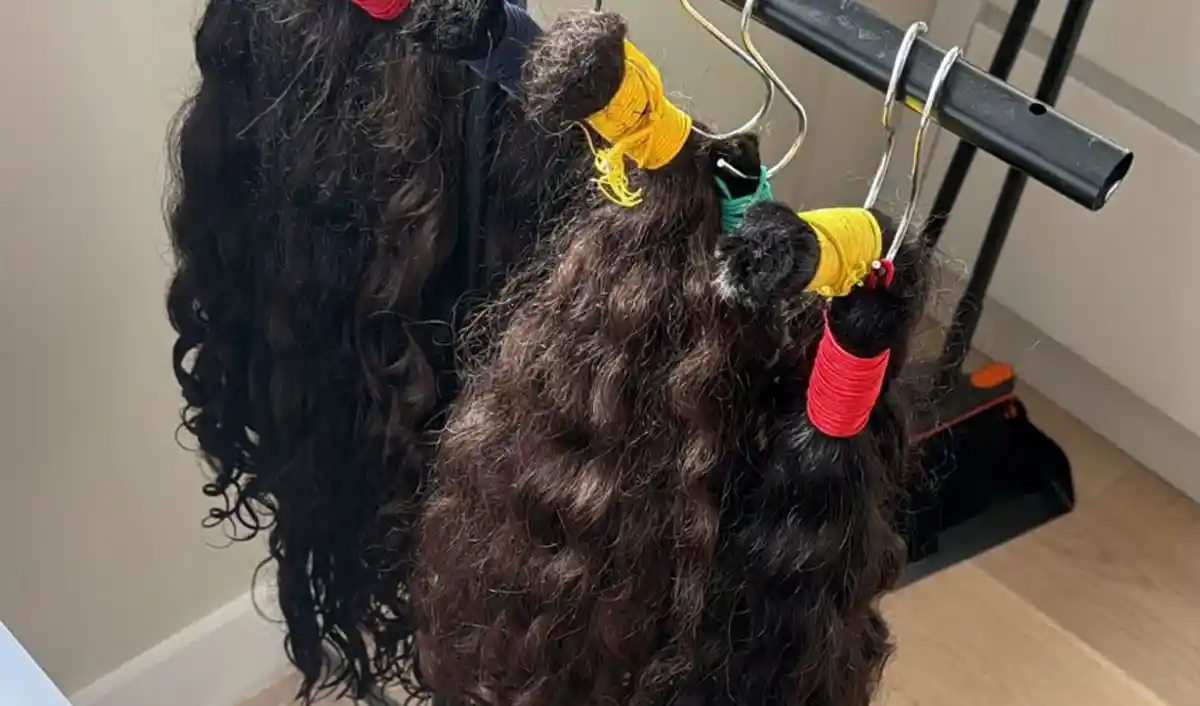
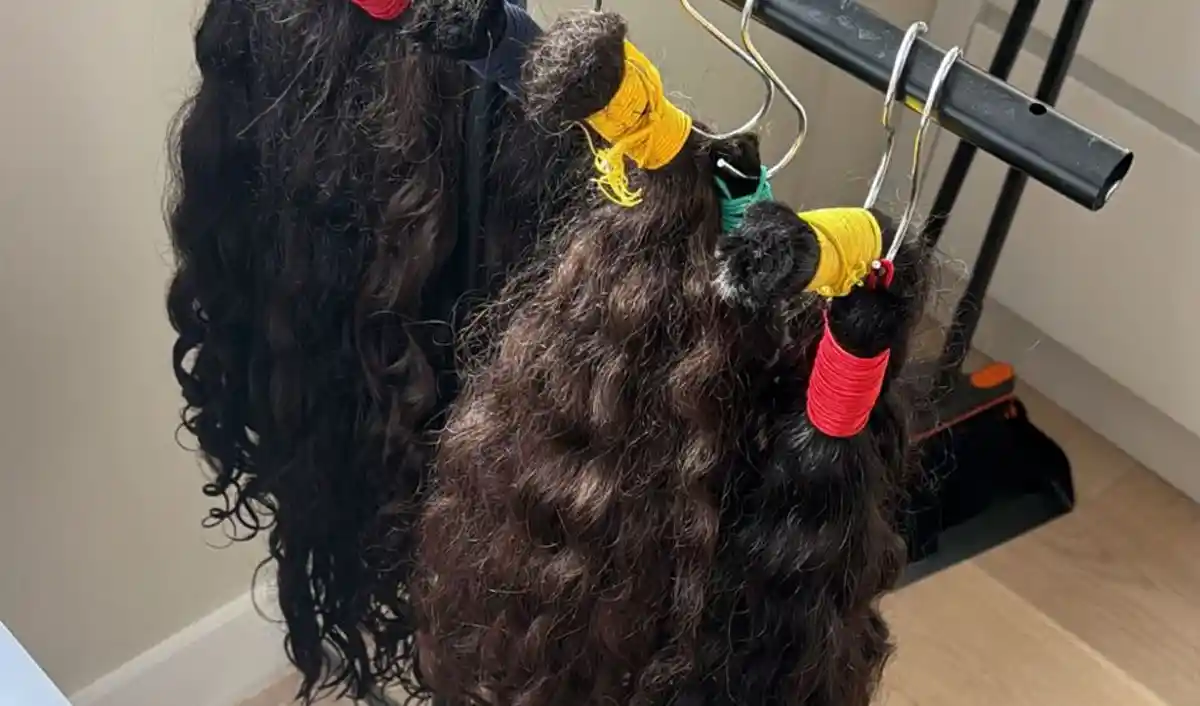
This is the hair we use at FAKE. Every set is hand-selected, hand-blended and colour-matched in the salon, including our wavy and curly stock — so curl pattern, density and tone are tuned to one specific head rather than to a catalogue page.
Why it's rare (and why it costs more)
Genuinely wavy and curly European hair is a minority trait. Research into hair-shape genetics has shown that variants of the TCHH gene — the single strongest genetic influence on hair shape in European populations — favour straight hair at their highest frequency.[10] Naturally curly donors are exactly that: a minority. The hair is harder to collect in matched lengths, harder to colour-sort, and available in smaller quantities.
That's reflected in the price. A curly set costs more than a straight one, and sometimes requires a lead time while we source and match the right stock. We're transparent about that, and we'll give you a specific quote at consultation.
But the maths works out differently when you factor in longevity. A set of naturally curly Eastern European hair, properly fitted and maintained, lasts 9–12 months between refits. A permed set that drops its curl after three washes isn't cheaper — it's a repeated cost with repeated disappointment.
How We Fit Curly Hair Extensions at FAKE
Two methods. One principle: the fitting has to protect your natural hair and respect the curl.
Keratin bonds for fine and delicate curly hair
Keratin bond extensions are individual strands, each tipped with a small keratin protein bond (roughly 3–5mm) that's fused to your own hair using controlled heat. For curly hair — especially finer curly hair — this is our recommended method.
Why? Because each bond is tiny, lightweight, and independent. There are no wefts pulling on a single anchor point. The weight is distributed across the entire head. And the bonds themselves sit flat against the scalp, which means they don't interrupt the curl pattern above them.
For perimenopausal women with thinning curly hair, for fine-haired women with delicate waves, and for anyone whose curl sits in the 2A–3A range on finer strands — keratin bonds are what we'll recommend nine times out of ten. You can read about safety and longevity in our posts on whether keratin bonds are safe and how long keratin bonds last.
Micro rings for thicker, stronger curly hair
Micro ring extensions use a small, silicone-lined metal ring to clamp the extension strand to your own hair. No heat, no adhesive. It's a solid, reliable method — but it requires hair with enough thickness and tensile strength to carry the ring comfortably.
If your curly hair is genuinely robust — thick individual strands, good density, a pattern in the 2C–3C range on strong hair — micro rings may be the right fit. They're faster to apply, faster to refit, and some women prefer the feel.
But we will never recommend micro rings as the primary method for fine or fragile curly hair. The ring concentrates weight at a single point, and fine curly hair is already more vulnerable to tension than fine straight hair, because the curl creates friction and movement around the bond. This is a hard rule at FAKE, not a preference. If your hair is fine, the answer is keratin bonds.
We've written a full comparison of both methods — how they work, who they suit, and the honest pros and cons — in our keratin bonds vs micro rings guide.
Aftercare for Curly Hair Extensions
Curly extensions aren't harder to look after than straight ones — but they are different to look after, and the difference matters.
Washing
Wash less frequently than you think. Curly hair — natural and extension — doesn't need daily washing. Two to three times a week is usually right. Use a sulphate-free shampoo (sulphates strip moisture aggressively, and curly hair is already more porous). Wash with the extensions hanging downward, not bunched up — this prevents tangling around the bonds.
Drying
Air-dry whenever possible. If you diffuse, use low heat and don't touch the curl while it's setting. The biggest aftercare mistake with curly extensions is handling them too much while wet — wet curly hair is more fragile, and excess manipulation breaks the curl clumps that give the set its definition.
Sleeping
Sleep with your hair in a loose, high pineapple or a silk bonnet. Cotton pillowcases create friction that disrupts curl pattern and causes tangles around the bond points. Silk or satin reduces friction by roughly 40–50% compared to cotton.
Products
Use lightweight products. Heavy oils and butters can weigh down the curl and build up around the bond area. A light leave-in conditioner and a curl-defining cream are usually all you need. Avoid anything with silicones if your hair is porous — they coat the cuticle and prevent moisture exchange, which worsens the porosity mismatch over time.
We cover all of this (and more) in our full aftercare guide.
What About Curl Types Above 3C?
Honest answer: FAKE specialises in the 2A–3C range because that's the range our Eastern European stock naturally covers. Our hair carries waves through to medium ringlets — it doesn't carry 4A coils or tighter.
If your curl pattern is 3C or tighter, the matching requirements go beyond what our current stock can meet. We'd rather tell you that honestly than fit you with hair that doesn't truly match your texture. If you're unsure where your curl falls, a consultation will give you a clear answer.
Ready for Curly Extensions That Actually Match?
Book a free consultation to discuss your curl type, density and goals with our specialist team.
Free consultation • No obligation • Expert guidance
FAQ
Can I get extensions if I have naturally curly hair?
Yes — but only with curl-matched stock, a fitting done dry with the curl in its natural shape, and a specialist who works this way as standard. Straight or permed hair fitted on curly natural hair will always read as two different textures, no matter how good the colour match is.
Why can't a salon just perm straight extensions to match my curls?
Perming breaks and reforms the disulfide bonds inside the hair in a weaker configuration. The curl quietly relaxes with every wash and heat session — typically losing noticeable definition within weeks. The strand's cross-section, cuticle weight and feel don't change either, so it never matches naturally curly European hair in person, even if it looks plausible in a photo.
How do I know what curl type I have?
Wash your hair with a gentle, sulphate-free shampoo. Skip all styling products. Let it air-dry completely without touching it. What you see is your natural curl pattern. If you have a mix of types (most people do), focus on the dominant pattern at your mid-lengths — that's where extensions will blend. We assess curl type in detail at every consultation.
Are keratin bonds or micro rings better for curly hair?
It depends on your strand thickness. Fine or delicate curly hair — including hair that's thinning due to perimenopause or other reasons — should be fitted with keratin bonds. They're lighter, distribute weight more evenly, and avoid concentrating tension at a single point. Micro rings suit thicker, stronger curly hair where the strand can comfortably carry the ring. We cover both methods in detail above.
How long do curly hair extensions last?
With correct aftercare, a curly set runs a similar lifespan to a straight one — 9–12 months of regular refits every 10–12 weeks. What shortens life in practice is porosity mismatch (causing tangling and dryness), over-washing, and excessive heat. All of these are addressed at the fitting and in the aftercare section above.
Do curly extensions need different aftercare?
Yes. Curly extensions benefit from less frequent washing (two to three times a week), air-drying where possible, sulphate-free products, and sleeping in a silk bonnet or on a silk pillowcase. Heavy oils and silicone-based products should be avoided as they weigh down the curl and build up around bond points.
If you have curly or wavy hair and you've been told you're "too difficult" for extensions, or you've had a set that dropped its curl within weeks — that wasn't you. It was the hair. Book a consultation and let's show you what the right hair, properly matched, actually looks like.
References
- [1]Loussouarn, G. et al. International Journal of Dermatology "Worldwide diversity of hair curliness: a new method of assessment" (2007) Available at: https://pubmed.ncbi.nlm.nih.gov/17214714/ DOI: 10.1111/j.1365-4632.2007.03453.x
- [2]Loussouarn, G. et al. International Journal of Trichology "Asian Hair: A Review of Structures, Properties, and Distinctive Disorders" (2020) Available at: https://pmc.ncbi.nlm.nih.gov/articles/PMC7187942/ DOI: 10.4103/ijt.ijt_87_19
- [3]Thibaut, S. et al. Experimental Dermatology "The what, why and how of curly hair: a review" (2019) Available at: https://pmc.ncbi.nlm.nih.gov/articles/PMC6894537/ DOI: 10.1111/exd.14011
- [4]Wortmann, F.-J., Wortmann, G. Journal of Cosmetic Science "Action of Thioglycolic Acid and L-Cysteine to Disulfide Cross-Links in Hair Fibers during Permanent Waving Treatment" (2003) Available at: https://www.researchgate.net/publication/244751910
- [5]Popescu, C., Wortmann, F.-J. Scientific Reports "Perm-waved human hair: a thermorheologically complex shape memory composite" (2021) Available at: https://pmc.ncbi.nlm.nih.gov/articles/PMC8456181/ DOI: 10.1038/s41598-021-98354-3
- [6]Morel, O.J.X., Christie, R.M. Journal of Applied Polymer Science "The susceptibility of disulfide bonds to modification in keratin fibers undergoing tensile stress" (2022) Available at: https://pmc.ncbi.nlm.nih.gov/articles/PMC9247342/ DOI: 10.1002/app.52491
- [7]Draelos, Z.D. Taylor & Francis "Hair Care: An Illustrated Dermatologic Handbook" (2005) Available at: https://www.taylorfrancis.com/books/mono/10.3109/9780203021644/hair-care-zoe-diana-draelos
- [8]Grymowicz, M. et al. Biomedicines "The Menopausal Transition: Is the Hair Follicle 'Going through Menopause'?" (2023) Available at: https://pmc.ncbi.nlm.nih.gov/articles/PMC10669803/ DOI: 10.3390/biomedicines11113178
- [9]Mirmirani, P. British Journal of Dermatology "Hormonal changes in menopause: do they contribute to a 'midlife hair crisis' in women?" (2011) Available at: https://pubmed.ncbi.nlm.nih.gov/22171682/ DOI: 10.1111/j.1365-2133.2011.10629.x
- [10]Medland, S.E. et al. The American Journal of Human Genetics "Common Variants in the Trichohyalin Gene Are Associated with Straight Hair in Europeans" (2009) Available at: https://pmc.ncbi.nlm.nih.gov/articles/PMC2775823/ DOI: 10.1016/j.ajhg.2009.10.003